Best Bible Study Tools for Deeper Reading

Best Bible Study Tools for Deeper Reading
If you want to read Scripture more carefully, teach it more faithfully, or publish it more effectively, the challenge is rarely a lack of passion. The real problem is knowing which Bible study tools you actually need first - and which ones only become useful later.
Many guides lump everything together: study Bibles, concordances, commentaries, lexicons, apps, maps, journals, and software. That is helpful up to a point, but it often leaves pastors, students, and everyday readers with the wrong next step. A beginner does not need the same setup as a preacher preparing a series through Romans. A mission team working across languages does not need the same workflow as a seminary student doing Hebrew word studies.
This guide is built to solve that. It explains the essential categories of tools to help study the Bible, shows who needs which tool first, and makes clear when deeper original-language work becomes necessary.
At Publifye AS, we work at the point where Bible publishing, Bible research, and church technology meet. That means this guide is not just theoretical. It reflects the real needs of churches, ministries, educators, and Scripture readers who need trustworthy access to the Bible in many languages, dependable original-language tools, and publishing systems that can move content from study to teaching to distribution.

What most competing guides get right - and what they miss
The strongest competitor articles agree on several important points:
- You should begin with the Bible itself, not secondary tools.
- Study Bibles, commentaries, concordances, and dictionaries are useful layers.
- Reading in context matters more than chasing isolated verses.
- Original-language tools can deepen understanding when used carefully.
- Notes, journaling, and cross-references are still highly effective.
Those are solid foundations. But there are also clear content gaps.
Content gaps most articles leave unresolved
1. They rarely tell readers what to use first
Many roundups list ten or twenty-nine tools but do not prioritize them. That creates friction. Readers need a sequence, not just a catalog.
2. They under-explain when original-language study becomes worthwhile
Some articles mention Hebrew and Greek as advanced options, but do not explain the threshold: when does a pastor, teacher, or student actually benefit from morphology, lexicons, and interlinear comparison?
3. They often treat multilingual ministry as an edge case
For churches, mission groups, and global ministries, multilingual access is not optional. It is central. A serious guide should address side-by-side reading across languages, terminology consistency, and distribution across formats.
4. They separate study from publishing
In practice, churches do not just study Scripture. They teach it, print it, send it by email, upload it to the web, prepare PDFs, and often package it for classes or outreach. The best biblical study tools should support that whole chain.
5. They ignore infrastructure
A church may have excellent content and poor delivery. If websites, backups, email systems, payments, or member access fail, ministry suffers. That is why reliable digital infrastructure belongs in the broader conversation about Bible tools.
The right order: which Bible study tools matter most at each stage
The simplest way to choose wisely is to think in layers.

Study Level
First Tools to Add
Why They Matter
Who Benefits Most
Beginner
Reliable translation, reading plan, cross-references, notebook
Builds habits and basic context
New readers, church members, youth
Growing reader
Study Bible, commentary, concordance, Bible dictionary
Explains background and recurring themes
Small-group leaders, serious lay readers
Teacher or preacher
Multiple translations, original-language tools, parallel reading, topical research
Supports accurate interpretation and lesson prep
Pastors, Bible teachers, Christian educators
Advanced student
Lexicons, morphology, textual comparison, scholarly commentaries
Enables close exegesis and language-aware study
Seminary students, theologians, researchers
Publishing ministry
Custom Bible building, terminology management, multi-format publishing, managed infrastructure
Moves Scripture from study into distribution
Churches, mission agencies, publishers
Start here: the Bible text itself
This may sound obvious, but it is where many people drift. They read notes about Scripture more than Scripture itself.
A deeper reading begins with a trustworthy Bible translation and a pattern of reading whole sections in context. Before buying more tools, make sure you can do three things well:
- Read complete paragraphs and chapters.
- Compare at least two translations side by side.
- Trace repeated words, themes, and cross-references.
That alone will improve Bible research more than jumping immediately into advanced software.
Why multiple translations help
Not because truth changes, but because translation decisions reveal nuance. A word-for-word rendering may preserve formal structure, while a thought-for-thought translation may clarify idiom or flow.
For this reason, one of the most practical Bible reference tools is parallel reading. Comparing translations side by side helps readers see where a passage is straightforward and where interpretive questions begin.
At Publifye AS, this is one reason we emphasize access to 4,200+ Bible translations across many languages, along with side-by-side comparative reading and offline Bible access on mobile and desktop. For a local church, that means better discipleship. For a mission team, it means real multilingual ministry. For a teacher, it means less guesswork.
Tool category 1: translations
Translations are not just preferences; they are the foundation of all further study.
What a good translation setup looks like
A practical setup includes:
- One main translation you read regularly
- One more literal translation for close study
- One more idiomatic translation for clarity
- If needed, a second language edition for bilingual ministry
Who needs this first?
Everyone.
What problem it solves
It lets you distinguish between:
- what the text clearly says,
- what depends on translation choices,
- and where deeper study may be needed.
"As of September 2023, the full Bible has been translated into 736 languages." - Wycliffe Global Alliance
That matters because the global church does not study in one language. A serious ministry platform must account for multilingual reading, teaching, and distribution.
Tool category 2: cross-references
Cross-references are among the most underrated free Bible study tools.
They show where Scripture interprets Scripture. A good reference chain can connect prophecy to fulfillment, theme to theme, and doctrine to doctrine without forcing the reader into speculative connections.
What they are best for
- Tracing repeated themes such as covenant, kingdom, holiness, exile, resurrection
- Following quotations of the Old Testament in the New Testament
- Seeing how one biblical author uses another
Who should use them?
Everyone beyond absolute beginners.
Common mistake
Using cross-references to jump too fast without first understanding the original passage in its own setting.
Tool category 3: concordances
A concordance helps you find where words occur across Scripture. This is useful, but it must be used carefully.
What a concordance does well
- Finds repeated words and themes
- Supports topical study
- Helps trace language habits of biblical authors
- Reveals how a term appears in different contexts
What it does not do
It does not automatically tell you what a word means in every passage. Meaning comes from context, grammar, genre, and usage - not from counting occurrences alone.
Who needs a concordance first?
- Small-group leaders
- Teachers preparing thematic studies
- Readers doing serious topical work
Beginner caution
Do not build a doctrine by stringing together verses that happen to use the same English word.
Tool category 4: Bible dictionaries and encyclopedias
These tools explain people, places, customs, institutions, and theological concepts.
When you encounter words like Pharisee, shekel, synagogue, covenant, or Judea, a dictionary can save time and prevent confusion.
What these are best for
- Historical and cultural background
- Quick explanation of unfamiliar terms
- Place names and geography
- Overview of theological concepts
Who should prioritize them?
Anyone who regularly runs into passages that feel foreign because of distance in time, place, or culture.
Why this matters more than many realize
The Bible was written in real places, among real peoples, within real linguistic and covenantal settings. Background is never the final meaning, but it often removes avoidable misunderstanding.
Tool category 5: commentaries
Commentaries are most helpful after you have observed the text yourself.
Many competing articles recommend commentaries early, and they are right to value them, but the sequence matters. If you consult a commentary too soon, you may borrow conclusions without learning to read carefully.
What a commentary should help you do
- Understand literary structure
- See interpretive options
- Learn historical and theological background
- Evaluate difficult passages responsibly
- Connect interpretation to doctrine and application
Which users need commentaries most?
- Bible teachers
- Pastors
- Students writing papers
- Readers working book by book through Scripture
Best practice
Use more than one, especially when the passage is debated. No commentary is inspired.
Tool category 6: lexicons
A lexicon is a dictionary for Hebrew, Greek, or Aramaic terms. It helps you study original-language words more accurately than an English concordance alone.
When a lexicon becomes useful
A lexicon becomes valuable when you need to ask questions such as:
- Which Greek or Hebrew word is behind this English translation?
- What range of meaning does this term carry?
- Is the same word translated differently elsewhere?
- Does the context favor one sense over another?
Who actually needs lexicons?
Not every reader. They become especially useful for:
- pastors preaching expositionally,
- seminary students,
- translators,
- theologians,
- advanced Bible teachers.
Common misuse
Many people treat lexicon entries as if every possible definition belongs in every verse. That is not how language works. Lexicons provide possible senses, not automatic meanings.
Tool category 7: morphology and original-language analysis
This is where Bible study becomes more technical.
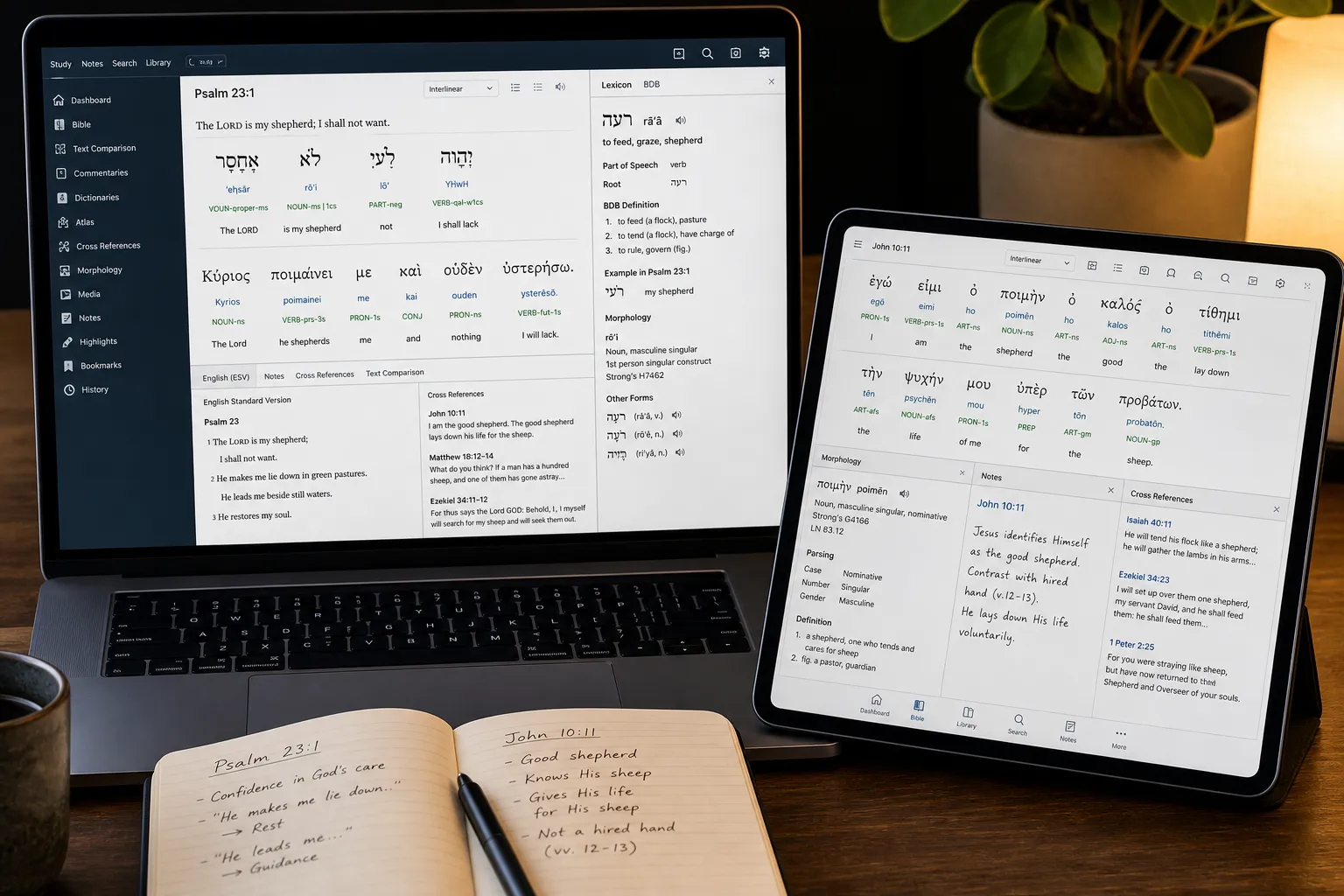
Morphology identifies the grammatical form of words: tense, case, number, gender, stem, voice, and related features. This can affect interpretation in meaningful ways.
When deeper original-language work is worth it
You should consider Hebrew and Greek tools when:
- A sermon or class depends on a disputed wording
- Translations differ noticeably
- The passage turns on grammar
- You are teaching regularly and need more precision
- You are doing translation, curriculum, or publishing work
When it is not yet necessary
If you are still struggling to read whole chapters in context, original-language tools are probably not your next step.
What advanced users need
Advanced users benefit from:
- lexicons,
- interlinear views,
- morphology tagging,
- cross-references,
- textual comparison,
- linked dictionaries,
- note systems that preserve findings for reuse.
At Publifye AS, this is exactly where Darash serves pastors, teachers, and researchers. It supports original-language Bible research with Hebrew and Greek tools, lexicons, morphology, and linked cross-references - helping users move from curiosity to disciplined exegesis without flattening the text into simplistic word studies.
Tool category 8: study Bibles
Study Bibles remain one of the most effective on-ramps for growing readers.
They combine the Bible text with concise notes, introductions, maps, and references. They are especially useful for readers who want guided help without building a large library.
Their main strengths
- Fast orientation
- Book introductions
- Helpful notes on difficult verses
- Basic theological and historical context
Their main limitation
Their notes are selective, brief, and shaped by editorial decisions. They are useful guides, not final authorities.
Who should start here?
- New Christians
- Busy parents
- Youth leaders
- Church members growing from devotional reading into study
Tool category 9: maps, timelines, and geography
Some competitor articles mention maps, but often as an afterthought. That is a mistake.
Geography is often interpretively significant. Distance, terrain, political boundaries, trade routes, exile locations, temple geography, and missionary journeys can all matter.
What maps and timelines help you see
- How events relate spatially
- Why one city or region matters
- Travel patterns and political pressure
- Chronological relationships between kings, prophets, and empires
Who needs them most?
Visual learners, teachers, and anyone studying narrative books, Acts, or the prophets.
Tool category 10: notes, journals, and annotation systems
A journal sounds simple, but it is one of the most durable biblical study tools you can use.
Why note-taking matters
It slows you down. It forces observation. It creates a record of patterns, questions, and answered prayers. It also turns passive reading into active engagement.
The digital advantage
A strong digital system allows notes to be:
- searchable,
- reusable,
- linked to passages,
- synchronized across devices,
- portable across future teaching and publishing workflows.
That matters for readers, but it matters even more for ministries producing courses, sermons, discipleship resources, and multilingual content.
Which users need which tools first?
For new Bible readers
Start with:
- one reliable translation,
- one comparison translation,
- cross-references,
- a notebook or note system,
- a good study Bible.
Do not begin with lexicons or technical commentaries.
For growing church members and small-group leaders
Add:
- a Bible dictionary,
- a one-volume commentary,
- a concordance,
- maps and timelines.
This gives enough depth without overwhelming the process.
For pastors and preachers
Add:
- multiple translations in parallel,
- original-language access,
- morphology tools,
- stronger commentaries,
- linked note and sermon systems.
If you preach weekly, the time saved by integrated Bible tools is significant.
For seminary students and theologians
Add:
- advanced lexicons,
- original-language search,
- textual comparison,
- scholarly reference works,
- terminology control across papers and projects.
For churches, ministries, and mission organizations
Add:
- multilingual Bible access,
- custom publishing workflows,
- dictionary and terminology management,
- multi-format publishing,
- reliable infrastructure behind distribution.
A simple progression plan
Here is a practical way to build your toolkit without wasting money or attention.
Phase
Add These Tools
Avoid for Now
Month 1
Main Bible, comparison Bible, reading plan, notes
Technical lexicons
Months 2–3
Study Bible, cross-references, Bible dictionary
Large commentary sets
Months 4–6
One-volume commentary, concordance, maps
Advanced textual criticism
Ongoing teaching
Parallel translations, original-language tools, deeper commentaries
Collecting resources without a workflow
Ministry publishing
Terminology systems, custom Bible creation, multi-format export, managed hosting
Fragmented tools that do not work together
Why integrated platforms matter more than isolated tools
One of the biggest unspoken issues in Bible study today is fragmentation.
A church may read Scripture in one app, write notes in another, prepare lessons in a word processor, email PDFs from a third system, publish to the web from a fourth, and manage member access somewhere else. That is inefficient and often fragile.
A stronger model is integration.
What integration changes
It allows ministries to:
- study in one place,
- preserve terminology consistently,
- build custom Scripture selections,
- publish from a single source,
- distribute to web, PDF, EPUB, and print,
- serve multilingual audiences,
- and protect the whole system with dependable infrastructure.
That is why Publifye AS built a vertically integrated approach rather than offering rigid disconnected plans.
Where Publifye fits naturally
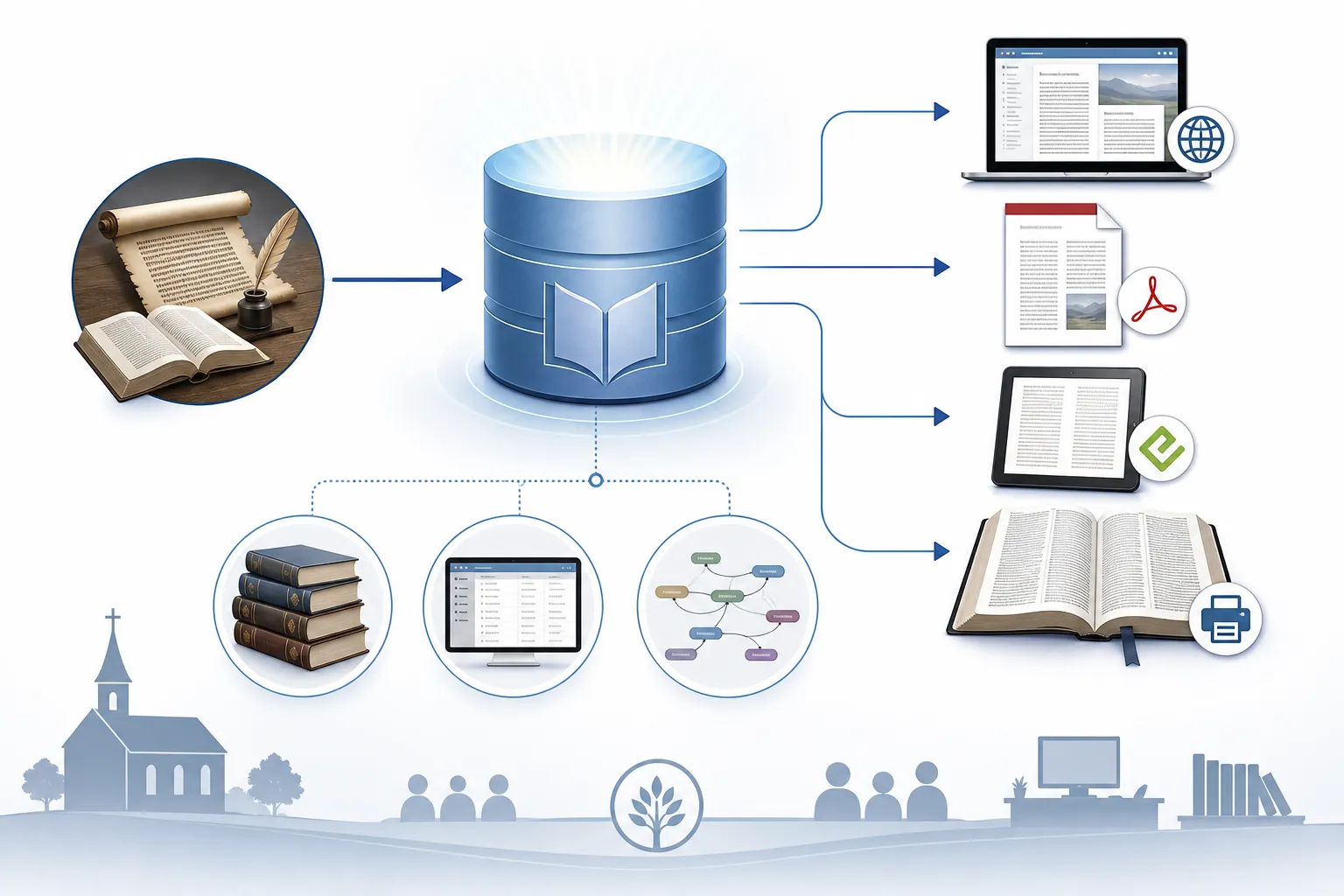
Publifye supports the entire Scripture workflow:
- Bible access: more than 4,200 digital Bible editions across many languages
- Study: original-language research through Darash
- Terminology: reusable dictionary and term management through Lexifye
- Custom Scripture publishing: class, outreach, and preaching resources through Tringine
- Multi-format output: web, PDF, EPUB, and print through Junifye
- Church infrastructure: managed websites, email, backups, payments, member sign-in, and delivery systems
- Mission support: free Bible distribution for churches and ministries through a gifting programme
If your ministry needs bespoke support rather than a one-size-fits-all subscription, you can explore how Publifye approaches custom church technology and publishing through our church and ministry support services.
Free vs paid tools: what is worth paying for?
Many readers search for free bible study tools, and rightly so. There are excellent no-cost ways to begin.
Use free tools for
- reading multiple translations
- basic note-taking
- cross-reference exploration
- introductory dictionaries
- simple topical studies
Pay when you need
- better workflow efficiency
- multilingual depth
- original-language precision
- reusable publishing outputs
- stable ministry infrastructure
- organizational control over terminology and distribution
Free tools are ideal at the beginning. Paid systems become worthwhile when ministry complexity, teaching frequency, or publishing needs increase.
"At least some Scripture is available in 3,756 languages used by 7.9 billion people." - Wycliffe Global Alliance
That statistic highlights a major ministry reality: Scripture access is not merely about private reading. It is about global availability, language stewardship, and distribution systems that can actually deliver content where it is needed.
Common mistakes when choosing Bible study tools
Buying advanced tools too early
This often leads to confusion, dependency on technical language, or abandoned resources.
Relying on one commentary voice
This narrows judgment and can hide interpretive alternatives.
Treating English word searches as original-language proof
A concordance is helpful, but it is not a substitute for lexical or contextual analysis.
Ignoring multilingual realities
Churches increasingly disciple people across languages. Your tools should reflect that.
Separating study from ministry output
If your lessons, class notes, devotionals, and sermon series must eventually be published, distributed, or archived, choose systems that support the whole chain.
How to know you are ready for original-language tools
You are probably ready if:
- You regularly compare translations and notice meaningful differences
- You teach or preach often enough that precision matters
- You are asking grammatical, lexical, or text-critical questions
- You need more than devotional help
- You want to evaluate secondary sources more responsibly
You are probably not ready if:
- You rarely read whole chapters
- You are not yet comfortable tracing context
- You use advanced tools mainly to find impressive details
- You are substituting technical terms for patient reading
A practical decision framework
Ask these five questions before adding a new tool:
1. What problem am I solving?
Confusion? Background? Original-language precision? Publishing workflow?
2. How often will I use it?
A preacher and a casual reader should not buy the same stack.
3. Does it help me read the text itself more carefully?
If not, it may be a distraction.
4. Does it fit my ministry context?
Monolingual private reading is different from bilingual classes, mission work, or church publishing.
5. Does it work with the rest of my system?
The best Bible study tools are not just powerful; they are usable together.
Final verdict
The best Bible study tools for deeper reading are not the longest list or the most technical stack. They are the right tools in the right order.
Start with a trustworthy translation, comparison reading, cross-references, and notes. Then add dictionaries, concordances, and commentaries as your questions deepen. Move into lexicons and morphology when your teaching, research, or publishing work truly requires original-language precision.
For ministries, the real breakthrough comes when study, publishing, and delivery are no longer separate tasks. That is where Publifye AS offers unusual value: not only Bible access and biblical research tools, but also the publishing engines and managed church infrastructure needed to move Scripture faithfully from source to audience.
If you need multilingual Bible access, original-language depth, custom Bible building, or a dependable digital backbone for church publishing, explore Publifye AS and consider starting a conversation through our contact page. Whether you are serving a local congregation or a multilingual mission field, the goal is the same: clearer access to God’s Word, handled carefully and shared well.
FAQ
How to go deeper in Bible study?
Start with careful reading in context, then add tools in sequence: a second translation, cross-references, a study Bible, a dictionary, and a commentary. Go deeper still when needed through original-language tools such as lexicons and morphology, especially if you teach or preach regularly.
What are the best Bible study tools?
The best tools depend on your level, but the core set includes reliable Bible translations, cross-references, concordances, Bible dictionaries, commentaries, and original-language resources. For ministries, the best setup also includes multilingual access, publishing workflows, and dependable digital infrastructure.
Which generation will not pass away?
This question usually refers to Jesus’ words in the Gospels, and responsible interpretation requires context, cross-references, and good commentary work. The answer depends on how one understands the surrounding discourse, so deeper study tools are important rather than isolated proof-texting.
What religion is Kristi McLelland?
Kristi McLelland is known as a Christian Bible teacher. Since this article focuses on Bible study tools rather than public biographies, readers should verify personal background details through her official channels or publisher materials.
What church does Kristi McLelland attend?
Church affiliation details can change over time, so the most accurate source would be her current official website or ministry profile. In general, it is wise to confirm these details directly rather than relying on secondary summaries.
What is Kenneth Copeland's religion?
Kenneth Copeland is a Christian minister associated with charismatic and Word of Faith circles. As with all teachers, readers should use sound Bible study tools and careful scriptural evaluation when assessing doctrine.