Bible Translations Explained Clearly

Bible Translations Explained Clearly
Choosing a Bible translation should not feel like guessing in the dark. Pastors need something reliable for preaching. Teachers need something clear enough for students. Everyday readers want a Bible they can actually keep reading. And serious students of Scripture often need to compare multiple Bible translations side by side to see where wording, tone, or manuscript decisions differ.
That is why understanding Bible translations matters. Not because one version is secretly “the only faithful one,” but because every translation makes real decisions about language, readability, idioms, manuscript evidence, and theological clarity. The goal of this guide is simple: explain those decisions in plain English so you can choose wisely for study, teaching, discipleship, and daily reading.
If your work involves multilingual ministry, publishing, or church technology, the question gets even bigger. You may need access to various Bible translations across many languages, offline reading for travel or outreach, original-language research tools, or the ability to publish Scripture-rich material to web, PDF, EPUB, and print from one workflow. That is where Publifye AS stands apart: it combines Bible publishing, study tools, and church-ready infrastructure in one ecosystem rather than treating them as separate problems.
What the top-ranking guides get right - and what they often miss
The strongest competitor articles tend to agree on a few important truths:
- there is no single perfect English translation
- translation philosophy matters
- readers should choose based on purpose, not hype
- comparing versions is often better than relying on one alone
- formal, dynamic, and paraphrased approaches each have strengths
Those are good foundations. But most guides also leave several content gaps:
- They oversimplify the spectrum. Many articles treat translations as if they fit into rigid boxes, when most move along a range depending on the passage.
- They do not explain task-based choice well enough. “Best Bible translation” changes depending on whether you are preaching, teaching children, doing exegesis, or reading devotionally.
- They rarely address multilingual and publishing realities. Churches and ministries do not only need English comparisons; they need Bible translation languages, distribution workflows, and sometimes custom Scripture editions.
- They separate reading from infrastructure. In practice, ministries need more than texts: they need reliable delivery, offline access, email, member systems, backups, and content publishing.
- They often ignore side-by-side comparison as a method. Yet compare Bible translations work is one of the fastest ways to improve understanding.
This article fills those gaps.
Why there are so many Bible translations
The Bible was not written in modern English. The Old Testament was written mostly in Hebrew, with some Aramaic. The New Testament was written in Greek. Translators must carry meaning across:
- different languages
- different time periods
- different cultural assumptions
- different literary genres
- different manuscript traditions
That is why different biblical translations exist. Translators are not merely swapping one word for another. They are making judgments about grammar, idioms, poetry, metaphor, sentence structure, and how much explanation should happen in the wording itself.
A few common reasons translations differ:
No exact one-to-one equivalents
Some Hebrew and Greek words have a range of meanings. One English word may be too narrow, too broad, or too modern.
Idioms do not travel neatly
Ancient expressions can confuse modern readers if translated too literally. But if translators smooth everything out, readers may lose the imagery of the original text.
Manuscripts vary in small places
Not every surviving manuscript reads exactly the same in every verse. That does not mean the Bible is unstable; it means scholars weigh manuscript evidence carefully when preparing modern editions.
English keeps changing
A translation that was clear in 1611 may not communicate clearly now. That is one reason the KJV remains influential but challenging for many readers today.
The basic types of Bible translations
The simplest way to understand Bible translations is to think in terms of translation philosophy rather than “good versus bad.”
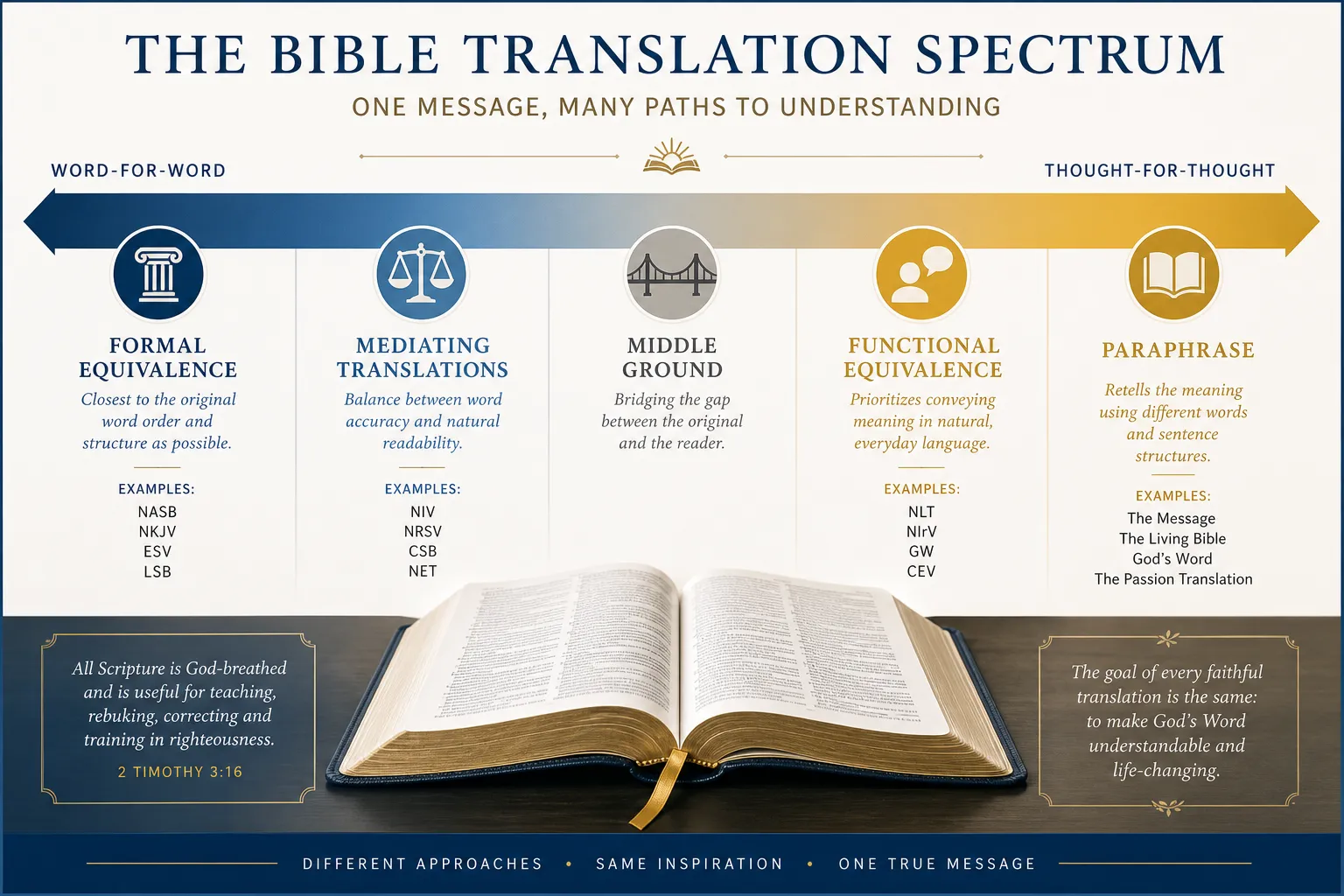
Formal equivalence: closer to word-for-word
Formal translations try to stay close to the wording and structure of the original languages.
Strengths
- good for close study
- preserves literary patterns
- helps readers notice repeated words and structure
- often preferred for exegesis
Weaknesses
- can sound stiff in English
- may preserve ambiguity or idioms without explanation
- can be harder for newer readers
Common examples
- KJV
- NKJV
- NASB
- ESV
- NRSV / NRSVue in many passages
Functional equivalence: closer to thought-for-thought
Functional translations aim to express the meaning of a phrase or sentence in natural English, even when that means departing from the original wording more than a formal translation would.
Strengths
- easier to read
- clearer for public reading and discipleship
- useful for children, new believers, and outreach
Weaknesses
- interprets more on the reader’s behalf
- may smooth away verbal connections important for study
- can narrow possible meanings in complex passages
Common examples
- NIV
- NLT
- CEB
- NIrV
Paraphrase: freer restatement for impact or clarity
Paraphrases are not usually meant to function as your only Bible for study. They restate the text more freely to help readers hear it freshly.
Strengths
- vivid
- accessible
- useful devotionally
- can wake readers up to familiar passages
Weaknesses
- highly interpretive
- less suitable for close doctrinal argument
- should be checked against a translation
Common examples
- The Message
- The Living Bible
A better way to think about the spectrum
Many articles imply that each version sits permanently in one category. In reality, translation is more dynamic than that.
A translation may be:
- quite literal in narrative
- more interpretive in poetry
- more explanatory in difficult idioms
- more conservative in doctrinally sensitive passages
So when readers ask about the type of Bible translations, the right answer is not a rigid chart alone. It is this: most translations mix strategies, but emphasize one side of the spectrum more consistently than another.
Bible translations compared: major English versions at a glance
Here is a practical comparison of popular Bible translations often considered when readers want all English Bible translations explained simply.
Translation
General Style
Reading Ease
Best Use
Watch For
KJV
Formal, historic
Hard
Literary tradition, historic study
Archaic English
NKJV
Formal
Medium
Traditional tone with updated language
Still somewhat formal
NASB
Very formal
Hard
Detailed study, exegesis
Less natural flow
ESV
Formal
Medium-hard
Study, teaching, preaching
Sometimes preserves difficult phrasing
NRSVue
Formal-moderate
Medium-hard
Academic study, broad ecumenical use
Some readers dispute certain inclusive renderings
NIV
Moderate
Medium-easy
General reading, church use, teaching
Some interpretive smoothing
CSB
Moderate
Easy-medium
Balanced reading and teaching
Less universally used than NIV
NLT
Functional
Easy
Devotional reading, outreach, younger readers
More interpretation in the text
CEB
Functional
Easy
Public reading, accessibility
More conversational style
The Message
Paraphrase
Very easy
Fresh devotional reading
Not ideal as a primary study text
What actually changes from one translation to another?
Readers often think differences are mainly about “big doctrinal issues.” Usually they are not. Most differences fall into a few ordinary categories.
1. Vocabulary choices
One translation may say “flesh,” another “sinful nature,” another “human nature,” depending on how it handles a Greek word like sarx in context.
2. Sentence structure
Greek can build long, layered sentences. Some versions keep that structure; others break it into shorter English sentences.
3. Idioms and metaphors
One version may preserve “gird up your loins.” Another may say “prepare yourselves for action.”
4. Gender language
Some versions retain terms like “brothers” even when the audience clearly includes women; others render “brothers and sisters” where the context warrants it.
5. Text-critical decisions
Verses like Matthew 17:21, Mark 16:9–20, John 7:53–8:11, and the longer reading in 1 John 5:7 are handled differently because manuscript evidence is weighed differently.
The manuscript issue: why some verses differ or are bracketed
This area causes more anxiety than it should. Most differences are not about someone “removing Scripture,” but about whether a line appears in the earliest and strongest manuscript evidence.
For example, some later manuscripts include readings that many modern critical editions place in footnotes or brackets. Older translations like the KJV may include them in the main text because they were based on different printed Greek editions available at the time.
The key point: major Christian doctrines do not stand or fall on these disputed verses. Modern translations are usually trying to be transparent, not evasive.
How to choose the best Bible translation for your purpose
The best translation of the Bible is usually the one that fits your task and keeps you reading faithfully.
Best Bible translation for study
If your goal is close reading, sermon prep, original-language tracing, or word study, choose a more formal translation as your anchor text.
Strong options
- NASB
- ESV
- NRSVue
- NKJV
Then compare it with a moderate or functional version so you can spot where the formal translation may sound wooden or obscure.
For deeper work, Publifye AS supports this kind of study particularly well. Its Scripture ecosystem is built not only for reading but for analysis: side-by-side comparison, offline access, and original-language research through Darash with Hebrew and Greek lexicons, morphology, and cross-references. That matters when the question is not merely “What does my favorite translation say?” but “What is this passage doing in the source text?”
Best Bible translation for everyday reading
If your goal is steady reading, family devotion, or broad comprehension, moderate and functional translations are usually better.
Strong options
- NIV
- CSB
- NLT
These are often the good Bible translations for readers who want clarity without drifting too far from the wording of the original.
Best Bible translation for teaching
For classroom use, small groups, or mixed-ability congregations, the ideal choice is often a moderate translation.
Strong options
- NIV
- CSB
- NRSVue in academic settings
If learners are very new to Scripture, using the NLT alongside a more literal version can work especially well.
Best Bible translation for public preaching
For preaching, you want a translation that is:
- accurate
- readable aloud
- widely available
- stable enough for teaching over time
Common choices
- NIV
- ESV
- CSB
- NKJV
Best Bible translation for children or emerging readers
Strong options
- NIrV
- NLT
- CEB
The goal here is not maximum technical precision in every clause. The goal is understanding.
Why comparing multiple translations is one of the smartest habits you can build
When readers compare Bible translations, they often discover one of three things:
- the wording difference is stylistic, not substantive
- one translation clarifies an idiom the other preserved
- a passage contains real ambiguity worth studying more carefully
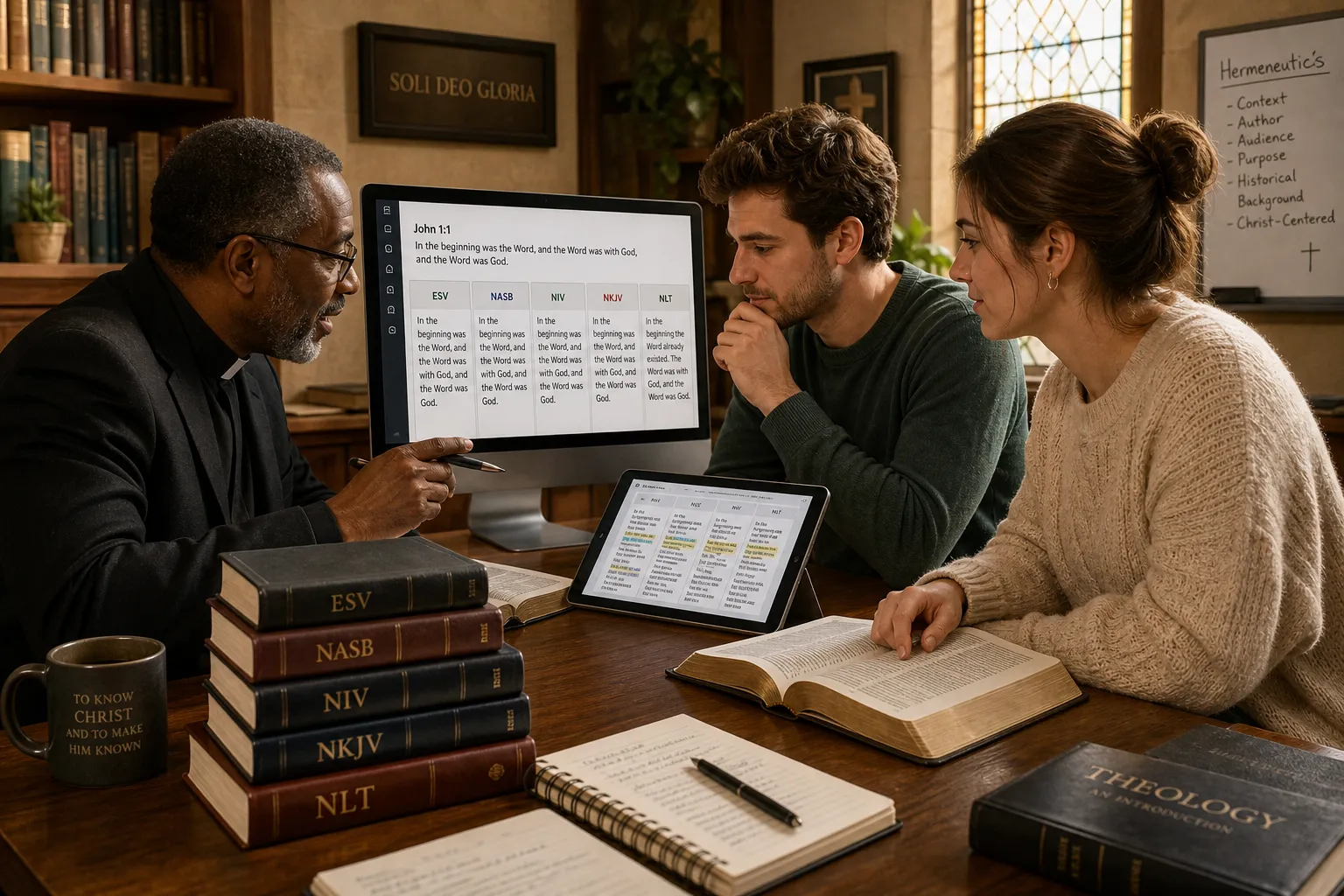
This is why multiple Bible translations side by side are so helpful. They do not create confusion when used properly; they expose where a text deserves closer attention.
A simple study method:
- Read the passage in your main translation.
- Compare it with one more formal version and one more functional version.
- Note repeated differences.
- Ask whether the difference is about wording, interpretation, or manuscript evidence.
- If needed, consult original-language tools or study notes.
This approach is especially valuable for pastors, teachers, and Christian educators who need to explain a text responsibly without overwhelming listeners.
A practical pairing strategy
If you are unsure where to begin, pair one translation with its complement.
If your primary Bible is…
Pair it with…
Why
ESV
NLT or NIV
Adds readability and clarity
NASB
CSB or NIV
Smooths difficult phrasing
NIV
ESV or NASB
Shows tighter formal structure
NLT
ESV or NKJV
Adds closer wording for study
KJV
NKJV or ESV
Retains tradition while improving clarity
The role of original-language tools
Even the best biblical translation is still a translation. There are times when pastors, translators, seminary students, and serious lay readers need to go deeper than English comparison alone.
That is where original-language tools matter:
- lexicons
- morphology
- cross-references
- textual notes
- semantic domains
- interlinked dictionaries
Publifye AS addresses this unusually well because it is not only a publisher of more than 4,200 Bible editions. It also develops the systems behind study and publication. With Darash for Hebrew and Greek research, Lexifye for reusable terminology and dictionary management, and Tringine for custom Bible creation, the company supports a workflow from exegesis to publication instead of leaving ministries to piece together disconnected tools.
For ministries producing lessons, outreach materials, or preaching series, that integration saves time and protects consistency.
A brief history that helps modern readers
You do not need a full seminary course in translation history, but a few moments matter.
Septuagint
A Greek translation of the Hebrew Scriptures made before the time of Christ, widely influential in Jewish and Christian history.
Vulgate
Jerome’s Latin translation, central in Western Christianity for centuries.
Wycliffe and Tyndale
Early English efforts made Scripture more accessible to ordinary people.
KJV
Published in 1611, profoundly influential in English-speaking Christianity.
Modern translations
The rise of textual criticism, manuscript discoveries, and modern English usage led to translations like RSV, NASB, NIV, NRSV, ESV, CSB, and NLT.
The larger point is simple: Bible translation has always been part of the church’s mission to make Scripture understandable.
Common myths about Bible translations
“Literal always means more accurate”
Not necessarily. A strictly literal rendering can become misleading when languages do not align naturally.
“Dynamic translations are untrustworthy”
Also false. They involve more interpretation, but they can communicate intended meaning very well, especially for modern readers.
“If verses are bracketed, the Bible is corrupted”
No. It usually means the translators are being honest about manuscript evidence.
“One translation is enough for every task”
Sometimes, but often not. Reading, preaching, teaching, and research do not always require the same tool.
“Newer translations are automatically better”
Not automatically. Some recent Bible translations improve readability or reflect newer scholarship, but usefulness still depends on your purpose.
Authority and scale: why multilingual access matters now
A major weakness in many articles about Bible versions and translations is that they assume the reader only needs one English Bible. Churches and ministries increasingly work across borders, devices, and formats.
That makes multilingual access a ministry issue, not just a technical convenience.
"This means some portion of the Bible has been translated into 3,415 languages." - Logos / Lexham Bible Dictionary article citing Wycliffe statistics
That scale matters for missions, diaspora congregations, theological education, and local churches serving multilingual communities.
Publifye AS is built for exactly that environment. Through its publishing and delivery ecosystem, ministries gain access to 4,200+ Bible translations across many languages, with offline reading on mobile and desktop for use in travel, low-connectivity settings, and local church life. If your ministry needs trustworthy Bible news and publishing updates, that broader Scripture and infrastructure perspective becomes critical.
Beyond reading: the hidden work ministries actually need
Most articles about online Bible translations stop at “Which version should I buy?” But many churches and ministries are really asking a larger question:
How do we read, study, publish, distribute, and manage Scripture-centered content well?
That includes:
- Bible access across languages
- custom study and preaching materials
- offline access
- websites and landing pages
- email delivery
- publishing pipelines
- backup systems
- payments and member access
- terminology consistency across teams
This is where Publifye’s vertically integrated model becomes genuinely distinctive. Through custom church technology services, ministries can move beyond rigid software plans and build a workflow fitted to actual church and mission needs. And because Junifye handles multi-format publishing from a single source to web, PDF, EPUB, and print, a lesson or study guide does not have to be rebuilt for every channel.
How to choose if you feel overwhelmed
If you still feel stuck, use this short framework.
Choose by primary use
- Close study: ESV, NASB, NRSVue, NKJV
- General church use: NIV, CSB
- Easy reading: NLT, CEB
- Historical/literary tradition: KJV
- Fresh devotional reading: The Message alongside a standard translation
Choose by reading level
If you struggle to stay engaged, readability is not a compromise. It is a ministry advantage.
Choose by community
Using the translation your church teaches from can reduce friction and help group study.
Choose by comparison habit
Whatever your main Bible is, build the habit of comparing other Bible translations regularly.
If you lead a church, school, or ministry team
You likely need more than a single recommendation. You may need a system for:
- teaching across age groups
- distributing study notes and reading plans
- publishing class materials
- offering free Bible access
- equipping multilingual congregations
- supporting offline use
- preserving theological terminology across languages
That is where Publifye AS becomes more than a content provider. It acts as a publishing and Scripture technology partner. Ministries can use its tools for custom Bible building through Tringine, manage reusable dictionaries through Lexifye, conduct source-text study in Darash, and publish from one workflow through Junifye. Churches that need broader operational support can also rely on managed church infrastructure and support for websites, email, backups, payments, and protected member access.
What to do next: a simple decision plan
If you want a practical outcome from this guide, do this:
- Pick one primary translation for the next 90 days.
- Add one comparison translation from a different point on the spectrum.
- Read a familiar passage in both.
- Note where they differ and why.
- If you teach or preach, check the original-language tools when the wording affects interpretation.
- If your ministry publishes or distributes Scripture content, choose a platform that supports the whole workflow, not just isolated reading.
Final verdict
The best Bible translation is not the one with the loudest marketing, the oldest history, or the most internet defenders. It is the one that helps you understand the text faithfully for the task in front of you - and keeps you returning to Scripture.
For most readers, that means:
- one reliable primary translation
- one or two comparison translations
- a willingness to study differences instead of fearing them
For churches, ministries, and Christian educators, it often means something more: a publishing and delivery system that can support multilingual Bible access, side-by-side comparison, original-language study, custom resources, and dependable digital infrastructure.
Publifye AS offers that uncommon combination. It does not simply provide Bible content. It supports the entire chain: Scripture publishing, comparative study, original-language research, custom Bible creation, multi-format publishing, and church-ready managed technology. If you want a partner that can help your ministry read, study, publish, and distribute Scripture with confidence, Publifye is built for that mission.
FAQ
What are the 5 most accurate Bible translations?
There is no universally agreed list of the five most accurate translations, because accuracy depends on what you mean by accuracy. For close study, many readers commonly trust the NASB, ESV, NRSVue, NKJV, and CSB because they aim for strong fidelity to the source text while remaining usable in English.
What is the simplest Bible translation to understand?
For many readers, the NLT is among the easiest mainstream translations to understand. For children or emerging readers, versions like the NIrV may be even simpler because they use shorter sentences and more basic vocabulary.
How can I understand the different translations of the Bible?
Start by learning the three broad approaches: formal, functional, and paraphrase. Then compare the same passage in two or three versions side by side and notice whether differences come from wording, readability, or manuscript choices.
Why is Matthew 17:21 removed from some Bibles?
It is usually not “removed” so much as placed in a footnote or omitted from the main text because many modern translators judge it to be absent from the earliest and strongest manuscripts. Older translations often include it because they relied on later manuscript traditions and printed Greek texts.
Which books were omitted from the Bible?
This depends on which Christian tradition you mean. Protestant, Catholic, and Orthodox canons differ, especially regarding the Deuterocanonical or Apocryphal books, so the question is usually about canon history rather than books being secretly removed later.
Why are some verses left out of the Bible?
Some verses are absent or bracketed in modern translations because translators are following earlier manuscript evidence and trying to present the text transparently. These differences are typically small and do not overturn the core teachings of Scripture.